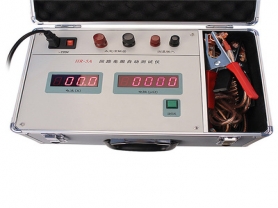

Of course. Here is an outline of an article about “Design and Application of High Current Generator”:
Design and Application of High Current Generator
Abstract
A high current generator is a device capable of producing high current, playing an important role in power systems, electrical equipment testing, and other applications requiring large currents. This article will introduce the design principles, key technologies, and applications of high current generators in various fields.
Introduction
High current generators can provide stable and controllable high current output, making them one of the indispensable testing tools in power systems. They are widely used in transformer characteristic testing, switchgear performance evaluation, relay protection testing, and other fields. With the continuous expansion of power system scale and technological advancement, the demand for high current generators is also increasing.
Design Principles
Power Module: Provides stable input voltage.
Current Amplifier: Converts input voltage into high current output.
Control Circuit: Regulates the magnitude and stability of the output current.
Protection Circuit: Ensures equipment safety, preventing overloading or short circuits.
Cooling System: Dissipates heat to maintain normal operating temperature of the equipment.
Key Technologies
High-Efficiency Power Amplifier: Utilizes advanced power amplification technology to improve efficiency and reduce heat generation.
Digital Signal Processing: Enables precise control and adjustment of output current.
Intelligent Protection System: Automatically detects abnormal conditions and takes appropriate measures.
Remote Control Function: Allows remote operation and monitoring via network or dedicated software.
Modular Design: Facilitates maintenance and upgrades.
Application Fields
Power System Testing:
Transformer Characteristic Testing: Used to measure transformer short-circuit impedance, no-load loss, and other characteristics.
Switchgear Performance Evaluation: Tests the breaking capacity of circuit breakers, disconnectors, and other equipment.
Relay Protection Testing: Simulates currents under various fault conditions to verify the response of protection devices.
Manufacturing:
Welding Equipment Testing: Evaluates the performance of welding equipment under high current.
Motor Performance Testing: Tests the current consumption of motors under different load conditions.
Scientific Research:
Material Performance Testing: Studies the physical and chemical property changes of materials under high current conditions.
Electromagnetic Compatibility Testing: Evaluates the stability of electronic devices in strong current environments.
Case Analysis
Transformer Short-Circuit Test: Simulates transformer short-circuit conditions using a high current generator to evaluate its short-circuit impedance and short-circuit loss.
Circuit Breaker Breaking Capacity Test: Uses a high current generator to test the breaking performance of circuit breakers under high current conditions.
Motor Overload Test: Simulates current changes under overload conditions to evaluate thermal stability and mechanical strength.
Conclusion
High current generators have wide applications in power system testing, manufacturing, scientific research, and many other fields. Through continuous technological innovation, these devices are becoming increasingly efficient, intelligent, and reliable. In the future, with the continuous development of power systems and technological advancement, high current generators will play a greater role in power engineering and scientific research.
The above is an overview of the “Design and Application of High Current Generator”. If you need more detailed information or have specific application scenarios you want to learn about, please feel free to let me know, and I would be happy to help.