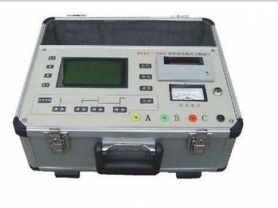

Main Functions and Features
High-Precision Measurement: It can provide very accurate resistance measurement results, typically with resolution reaching the micro-ohm (μΩ) level, which is essential for detecting subtle changes.
High Current Output: To overcome the influence of contact resistance and lead resistance, many loop resistance testers can output high currents up to several hundred amperes, thereby obtaining more accurate measurement results.
Fast Measurement: Utilizing advanced measurement techniques, it can complete resistance measurements in a short time, improving work efficiency.
Portability: Modern loop resistance testers are compact and lightweight, making them easy to carry to the field for testing work.
Application Scenarios
Power Transformer Maintenance: Regularly measuring the DC resistance of transformer windings is one of the important steps in assessing their condition, helping to detect issues such as broken strands or poor contact in the windings.
Switchgear Inspection: Conducting contact resistance tests on key components like circuit breakers and disconnectors in high-voltage switchgear to ensure good contact and avoid overheating due to poor contact.
Cable Joint Detection: After installing or repairing cables, use a loop resistance tester to verify the quality of joints, ensuring efficient current transmission.
Motor and Generator Inspection: By measuring the resistance of motor or generator windings, it can determine whether there are short circuits or open circuits, ensuring normal operation of the motor.
Importance
Accurately measuring the loop resistance in electrical equipment is of great significance for ensuring the safe and stable operation of the equipment. For example, in transformers, changes in winding resistance may indicate internal faults; in motors, it could be due to overheating or other mechanical damage. Timely detection of these issues and taking appropriate measures can avoid greater losses.
Furthermore, good contact resistance is also a key factor for efficient power transmission. If the contact resistance is too high, it not only leads to unnecessary energy loss but may also cause equipment damage or safety accidents.
Technological Advances
With the development of technology, the design of loop resistance testers is continuously improving:
Higher Precision and Stability: New models can provide higher resolution measurement results, allowing even subtle resistance changes to be accurately captured.
Enhanced User Interface: More intuitive interface design simplifies the operation process and reduces training requirements.
Intelligent Data Processing Capabilities: Built-in intelligent algorithms can help quickly identify abnormal patterns and provide diagnostic suggestions, improving work efficiency and accuracy.
Remote Monitoring and Support: Some high-end models support remote monitoring and data upload via the internet, allowing technicians to access information anytime, anywhere.
In summary, the loop resistance tester is an indispensable tool for ensuring the reliability of electrical equipment performance. Whether you are a professional electrical engineer or a researcher in related fields, mastering and properly using such equipment is very valuable. If you have specific application cases of loop resistance testers, how to choose a model that suits your needs, or any other related questions, please feel free to ask. I will do my best to help.
Considering the current time is March 12, 2025, if you want to learn about the latest technological advances in loop resistance testers or the newest models on the market, it is recommended to consult recent professional literature and technical reports to obtain the most cutting-edge information.