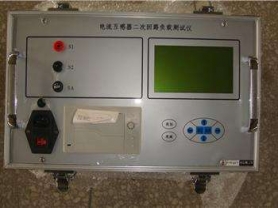

The dielectric loss tester (referred to as "dissipation factor tester") is a high-precision testing instrument used to evaluate the insulation health of power equipment.
If the transformer capacity characteristic tester is used to verify the transformer's "physique" (capacity size), then the dielectric loss tester is used to detect the "insulation quality" (insulation aging and moisture) of power equipment. It mainly measures two key indicators: the dielectric loss factor (tanδ or tgδ) and capacitance (Cx).
⚙️ Main Functions and Test Objects
This instrument is mainly used for preventive tests and fault diagnosis of insulation performance of various high-voltage power equipment in power plants, substations, on-site or in laboratories. Common test objects include:
Transformers and instrument transformers: Evaluate the aging degree of windings and overall insulation.
Power cables: Detect whether the cable insulation layer is damp or deteriorated.
Capacitors and bushings: Measure their capacitance and dielectric loss.
Insulating oil: With a dedicated insulating oil cup, it can test the dielectric loss of liquid insulating materials.
Working Principle
Its core principle is based on the AC bridge principle and digital signal processing (DSP) technology:
Generation of dielectric loss: Under AC voltage, insulating materials (dielectrics) consume part of the electrical energy and convert it into heat. This energy loss is dielectric loss. A phase difference is generated between voltage and current, and the tangent of the related angle (tanδ) is the core parameter to measure insulation loss.
Digital measurement: The instrument has a high-precision standard capacitor (standard circuit) and the device under test (test circuit). The instrument synchronously collects current signals from both circuits, and through high-speed A/D conversion and digital vector operations, accurately calculates the capacitance and dielectric loss factor of the test object.
Core Technology: Strong Anti-interference Capability
Due to the strong power frequency electromagnetic field interference often present on site, the most notable technical feature of modern dielectric loss testers is the frequency conversion anti-interference technology:
Heterodyne measurement: The traditional power frequency is 50Hz. The instrument automatically shifts the frequency of the test power supply (for example, using 45Hz/55Hz or 55Hz/65Hz heterodyne pairs).
Digital filtering: Combined with digital notch and FFT (Fast Fourier Transform) analysis technology, it can perfectly avoid and filter out the 50Hz power frequency interference on site, thereby extracting the true insulation signal in complex electromagnetic environments, ensuring the accuracy of measurement results.
Flexible Test Modes
To adapt to different wiring conditions of equipment, dielectric loss testers usually support multiple wiring and test methods:
Ungrounded test method: Suitable for cases where both poles of the test object are insulated from ground (such as coupling capacitors).
Grounded test method: Suitable for cases where one end of the test object is already grounded (such as transformer bushings, instrument transformers).
Self-excitation method: Specifically used to test capacitor voltage transformers (CVT), allowing one-step measurement of the dielectric loss and capacitance of the C1 and C2 sections of the CVT without dismantling the high-voltage leads.
Notable Features of Modern Instruments
Highly integrated: The instrument integrates a variable frequency voltage regulating power supply, step-up transformer, standard capacitor, and test bridge, with a built-in high-voltage source. No need to connect an external bulky test transformer. The weight is usually around 20 kg, making it easy to carry to the site.
Intelligent operation: Equipped with a large color touch screen and full Chinese menu, operators can get started without complex professional training. After the test, data can be automatically stored, printed, and exported via USB for computer analysis.
Multiple safety protections: It has multiple safety measures such as high-voltage short-circuit protection, overcurrent protection, grounding detection (ensuring that voltage cannot be raised if the instrument is not grounded), and an emergency stop button, ensuring the safety of personnel and equipment.
If you need test details for a specific type of equipment (such as CVT or insulating oil), or want to understand specific wiring and operation methods, feel free to tell me!