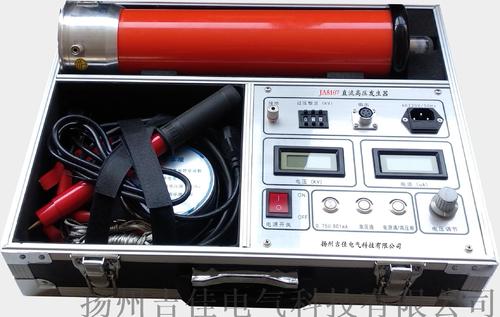

Overview of High Voltage Switch Characteristic Tester
Introduction
High voltage switches are one of the crucial components in power systems, and their reliability and stability directly affect the safe operation of the entire power grid. Therefore, regularly conducting characteristic tests on high voltage switches is one of the important means to ensure the normal operation of the power system. The high voltage switch characteristic tester is a dedicated testing device that can accurately measure the mechanical characteristics of high voltage switches. This article aims to introduce the basic principles, main functions, and usage methods of this type of tester.
Working Principle
The high voltage switch characteristic tester collects various data during switch operation through built-in sensors, such as time, displacement, speed, etc., and processes them through a data analysis system, ultimately generating a detailed test report. The tester typically includes the following parts:
Sensors: Used to capture physical parameter changes during switch operation.
Data acquisition system: Converts sensor signals into digital signals and performs preliminary processing.
Analysis and display module: Further analyzes the collected data and displays it in graphical form.
Main Functions
Time measurement: Simultaneously measures the inherent closing and opening times, phase difference times, bounce times, and bounce counts of multiple breaks.
Displacement and speed measurement: Simultaneously measures the opening distance, overtravel, total travel, maximum bounce amplitude, and opening (closing) speed of three phases.
Switch voltage action characteristic test: Provides action voltage through the built-in DC power supply.
Switch coil current waveform measurement: Records the current waveform during switch operation.
Reclosing test: Uses the built-in DC power supply as the operating power for high voltage switch reclosing to conduct reclosing tests.
Synchronization Modes
Internal synchronization: The tester itself provides voltage (DC30-300V) as the power source, and the switch's own power supply must be disconnected at this time.
External synchronization: Uses an external power supply (AC/DC30-300V) to provide voltage to the closing and opening coils, and inputs the external power signal into the tester as the reference for starting data collection.
Dry contact synchronization: Uses the switch's own power supply to power the closing and opening coils, while the tester only outputs passive closing and opening signals.
Test Items
Closing test: Measures the time interval from the moment the closing command is received to the moment all pole contacts touch.
Opening test: Measures the time interval from the moment the switch opening operation starts (i.e., the moment the opening command is received) to the moment all pole contacts are completely separated.
Bounce test: Measures the time from the first separation (contact) of the moving and stationary contacts during opening (closing) operations until they are stably separated (contacted).
Displacement and speed test: Measures displacement and speed using a linear motor and a grating ruler, obtaining travel-time curves and speed-time curves.
Usage Method
Set parameters: Use the "Settings" button on the tester to modify test parameters. Specific values can be entered via the keyboard, and the left and right arrows can be used to move the cursor.
Connect the switch: Connect the high voltage switch and the tester according to the specified synchronization mode.
Start the test: After confirming the connection is correct, start the tester to conduct the test.
Read data: After the test is completed, the test results can be read from the tester's display screen, including curves of parameters such as time, displacement, and speed.
Data storage and analysis: Test data can be saved in the instrument and can be analyzed later or transferred to a computer.
Technical Features
High-speed and high-precision data acquisition: Ensures the accuracy and real-time nature of data.
Large LCD screen: Facilitates observation of test results.
Data storage: Test data can be saved in the instrument for subsequent analysis.
Sensor compatibility: Supports multiple types of sensors, such as angle sensors, linear displacement sensors, and acceleration sensors.
Conclusion
The high voltage switch characteristic tester is crucial for the safe operation of power systems. By conducting regular tests on high voltage switches, potential problems can be detected in a timely manner, ensuring the stability and reliability of the power system. With continuous technological advancements, the functions of the high voltage switch characteristic tester will become more powerful, and its operation will become more convenient.
The above article outlines the main functions, working principles, usage methods, and technical features of the high voltage switch characteristic tester. I hope this information is helpful to you. If you need more detailed guidance or encounter specific problems, please feel free to ask.