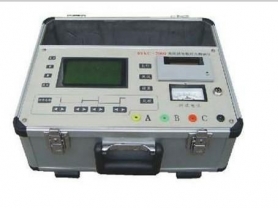

Of course, here is a draft article about the same-voltage wireless phase detector, which you can modify or supplement as needed:
Same-voltage Wireless Phase Detector: A Key Tool for Ensuring Synchronous Operation of Power Systems
Introduction
Background: The importance of phase sequence in power systems and its impact on power equipment.
Introduction to Same-voltage Wireless Phase Detector: Briefly describe the features of the same-voltage wireless phase detector and its important position in power systems.
Importance of Phase Sequence and Phase Detection
Definition: Phase sequence refers to the order of voltages in each phase of three-phase alternating current.
Importance: Correct phase sequence is crucial for the stable operation of power systems. Incorrect phase sequence can lead to motor reversal, equipment damage, and other issues.
Working Principle of Same-voltage Wireless Phase Detector
Signal Transmission and Reception: The transmitter sends signals of a specific frequency, and the receiver receives and analyzes these signals.
Wireless Communication: Uses wireless technology to achieve long-distance signal transmission, avoiding the inconvenience of traditional wired phase detectors.
Phase Comparison: Determines whether the phase sequence is correct by comparing the phase differences between different phases.
Features and Advantages of Same-voltage Wireless Phase Detector
Wireless Operation: No physical connection required, reducing safety risks.
Portability: Compact size, easy to carry to the site for testing.
Easy Operation: User-friendly interface, simple operation, no complex setup required to start testing.
Accuracy: Provides highly accurate phase measurement results.
Multi-function Integration: In addition to phase detection, it may also integrate other test functions such as voltage measurement.
Application Scenarios
New Projects: Phase sequence verification before commissioning of new equipment or lines.
Maintenance and Inspection: Regular phase sequence verification to ensure normal operation of power systems.
Fault Diagnosis: When phase sequence errors are suspected to cause equipment abnormalities, the phase detector is used to assist in diagnosis.
Testing Steps and Procedures
Preparation: Confirm the test object and select appropriate test locations.
Connecting Test Equipment: Place the transmitter and receiver correctly near the line to be tested.
Data Acquisition: Start the same-voltage wireless phase detector and operate according to the instruction manual.
Data Analysis: Use the accompanying software or directly view phase results on the device.
Result Interpretation and Recommendations: Determine whether the phase sequence is correct based on the analysis results and provide corresponding recommendations.
Implementation Case
Case Background: Describe a specific phase detection test case.
Testing Process: Detail the process of using the same-voltage wireless phase detector.
Data Analysis: Present the results of data analysis and explain their meaning.
Conclusion and Recommendations: Summarize the application effect of the phase detector in this case and propose improvement suggestions.
Technology Development Trends
Intelligence: With technological advancement, phase detectors are moving towards more intelligent development, such as the ability to automatically identify phase sequence.
Portability: Modern phase detectors increasingly focus on portability and ease of use to meet the needs of field testing.
Multi-function Integration: Future phase detectors may integrate more test functions to provide a more comprehensive assessment of power system performance.
Conclusion
Emphasize the importance of the same-voltage wireless phase detector in power system maintenance.
Point out the importance of regular phase sequence verification to ensure the stable operation of power systems.
References
List relevant technical standards, research literature, or industry guidelines for reference.
This framework covers the basic information and technical points of the same-voltage wireless phase detector. You can adjust and supplement it according to actual needs. I hope this article helps you better understand the same-voltage wireless phase detector and its application in power system maintenance.