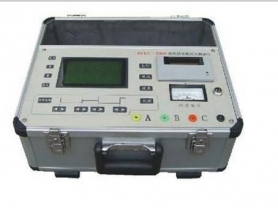

It is widely used in power systems, industrial production, and scientific research experiments. This type of tester helps technicians accurately assess the quality of electrical connections, detect the integrity of conductors, and identify issues such as poor contact or corrosion. Below is an article about DC resistance testers, covering their basic concepts, working principles, application scenarios, and usage precautions.
Overview of DC Resistance Tester
Definition and Function
A DC resistance tester is an instrument used to measure the DC resistance of conductors in electrical equipment. It is mainly used to detect the resistance values of transformers, motors, cables, relays, and other equipment in power systems, ensuring the quality of electrical connections and the good operating condition of these devices.
Importance
In power systems, if the DC resistance of conductors is too high, it may lead to equipment overheating, reduced efficiency, or even failures. Therefore, regular testing with a DC resistance tester is crucial for maintaining the safe and stable operation of power systems.
Working Principle
Testing Method
DC resistance testers typically use the constant current method for testing. During the test, the instrument applies a known DC current across the conductor under test and measures the voltage drop across it. According to Ohm's law
Operating Procedure
Connect test leads: Correctly connect the tester's test leads to both ends of the device under test.
Set parameters: Set the current intensity of the tester according to the resistance range to be measured.
Execute test: Start the tester to apply current to the device under test and record the voltage drop.
Read results: Calculate the resistance value based on the voltage drop and known current, and read the displayed result on the tester.
Record data: Record the test results, including resistance value, test time, and environmental conditions.
Application Scenarios
DC resistance testers are widely used in multiple fields:
Power systems: Used to detect the resistance values of transformers, circuit breakers, cables, and other equipment, ensuring the quality of electrical connections.
Industrial production: In the manufacturing and maintenance of motors, generators, and other equipment, used to check winding resistance and assess equipment health.
Scientific research: In laboratories, used to study the resistance characteristics of materials and develop new conductive materials.
Building electrical: Used for inspecting electrical systems in buildings to ensure reliable wire connections and avoid the risk of excessive heating.
Usage Precautions
Safety first: Ensure the device under test is de-energized before testing and take necessary safety precautions.
Correct connection: Ensure test leads are correctly connected to test points to avoid misconnection causing erroneous measurements.
Calibrate the instrument: Regularly calibrate the tester to ensure measurement accuracy.
Environmental factors: Pay attention to the temperature and humidity of the test environment, avoiding extreme conditions that may affect measurement results.
Complete records: Record detailed results of each test, including date, location, tester, etc., for future reference.
Development Trends
With technological advancements, DC resistance testers are continuously evolving:
Intelligence: Integrating more functions such as automatic data recording and remote monitoring.
Portability: Smaller size and lighter weight for easy carrying and use.
Multi-functionality: In addition to measuring resistance, other test functions such as insulation resistance testing and ground resistance testing are added.
High precision: Adopting more advanced measurement techniques to improve test accuracy and stability.
In summary, DC resistance testers are indispensable tools in power system maintenance, industrial production, and scientific research experiments. With continuous technological progress, future DC resistance testers will become more intelligent, portable, and have higher measurement precision, better serving the electrical equipment testing needs of various industries.