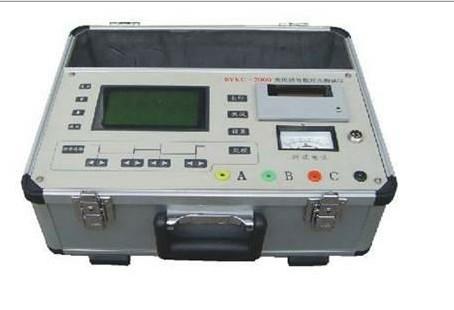

TAG8000 Wireless High-Voltage Phase Verifier is a professional tool used to detect whether the power sources on both sides of a circuit breaker at the closing point in a loop network or dual-power supply grid are in phase. Below is an outline of an article about the TAG8000 Wireless High-Voltage Phase Verifier:
TAG8000 Wireless High-Voltage Phase Verifier: Principles, Usage, and Maintenance
1. Introduction
Background: The safe and stable operation of the power system depends on the correct configuration and maintenance of power equipment, especially in dual-power supply systems, where ensuring phase consistency between power sources is crucial.
Role of the TAG8000 Wireless High-Voltage Phase Verifier: This instrument helps technicians accurately verify whether the phases of the power sources on both sides of the closing point are consistent, preventing short-circuit accidents caused by phase mismatch.
Research Purpose: This article aims to introduce the working principle, usage methods, and application of the TAG8000 Wireless High-Voltage Phase Verifier in power system maintenance.
2. Working Principle
Technical Features: The TAG8000 Wireless High-Voltage Phase Verifier adopts the latest power electronics detection technology and wireless transmission technology.
Signal Acquisition: Phase signals are obtained from the tested high-voltage power source through collectors.
Wireless Transmission: Wireless technology is used to transmit signals to the receiver for processing.
Data Analysis: The receiver's built-in software processes the signals to determine phase consistency.
Result Display: Based on the test results, it indicates whether the phases are consistent and also has a voltage detection function.
3. Usage Method
Equipment Preparation: Ensure that the batteries of the transmitter and receiver are fully charged and perform self-checks.
Connecting the Transmitter: Place the transmitter at an appropriate position on the tested high-voltage power source.
Receiving Signals: Use the receiver to receive wireless signals from the transmitter.
Reading Results: Observe the results displayed on the receiver to confirm whether the phases are consistent.
Precautions: During testing, personnel must wear insulating equipment and maintain a safe distance, and avoid interference from radio transmitting devices.
4. Technical Parameters
Operating Voltage: Suitable for transmission lines from 6kV to 35kV.
Wireless Transmission: Uses wireless transmission technology to ensure operational safety and reliability.
Anti-interference: Possesses strong resistance to electromagnetic field interference.
Display Interface: Equipped with a clear display screen for intuitive test results.
Additional Functions: Includes a voltage detection function.
5. Maintenance and Care
Daily Maintenance: Keep the instrument clean and dry, and avoid prolonged exposure to extreme temperatures or humidity.
Regular Calibration: Calibrate at intervals recommended by the manufacturer to ensure measurement accuracy.
Storage Conditions: Store in a dry and ventilated place when not in use to avoid moisture.
Precautions: Follow the safety guidelines in the operation manual to avoid safety accidents in high-voltage environments.
6. Application Case
Case Description: Introduce a specific case of using the TAG8000 Wireless High-Voltage Phase Verifier for phase verification, including the detection background, process, and results.
Result Analysis: Analyze based on the detection results, pointing out existing problems and possible causes.
Improvement Suggestions: Propose improvement measures or maintenance suggestions to enhance equipment performance.
7. Conclusion and Outlook
Summary: Review the importance and implementation process of the TAG8000 Wireless High-Voltage Phase Verifier.
Future Trends: Discuss the development trends of high-voltage phase verifier technology, such as intelligence and miniaturization.
8. References
Related Literature: List the relevant academic papers and technical reports cited in this article to provide readers with resources for further learning.
Please adjust or supplement the above outline according to your specific needs. If you need more detailed content or have other specific requirements, please let me know.