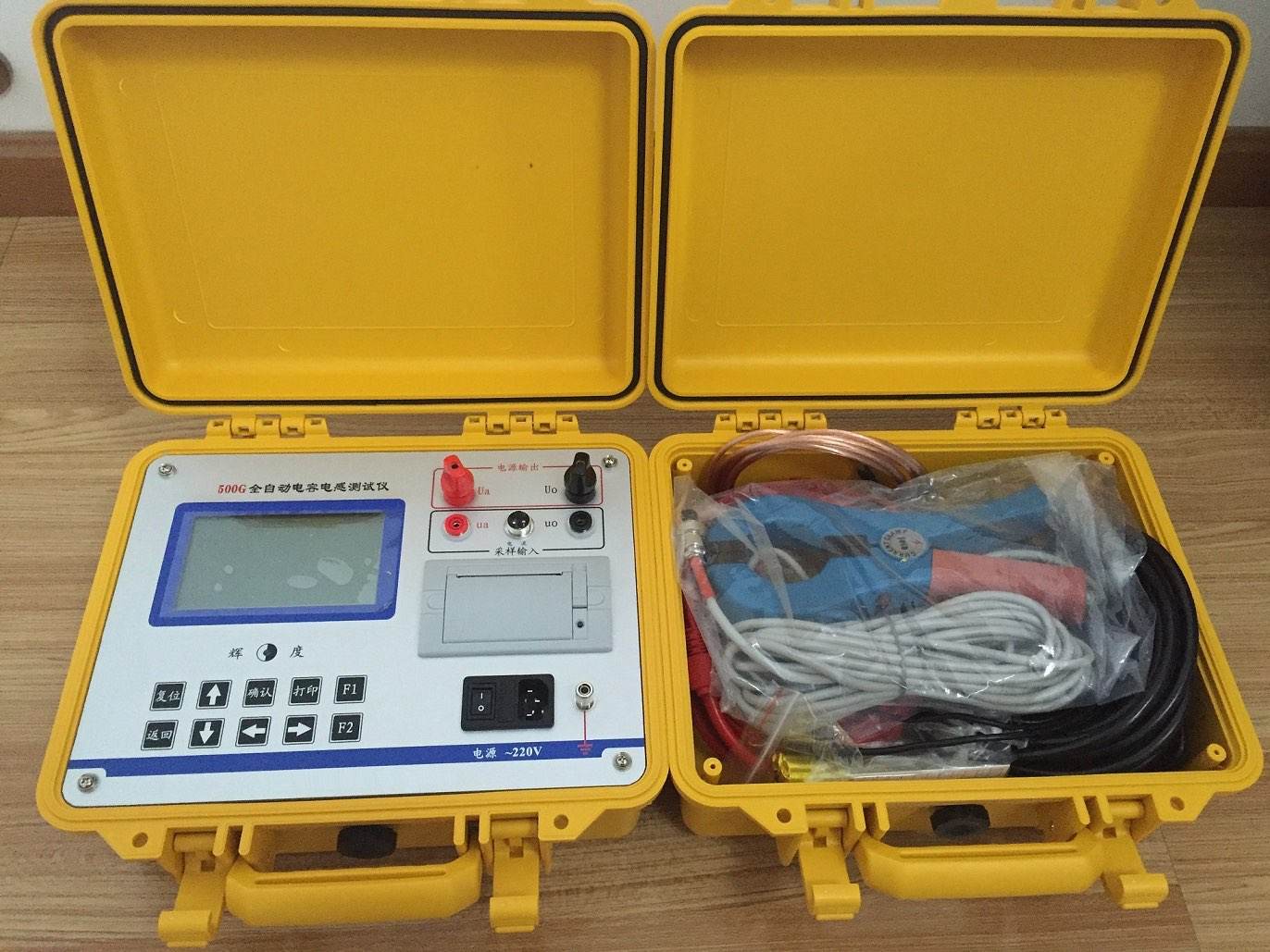
Instructions for Three-Phase Capacitance and Inductance Tester:
1. Test voltage: If the impedance of the test object is unknown, you can first test with 2V. If the test current is less than 1A, you can switch to 30V for measurement.
2. Current detection: Clamp the CT onto the part where current needs to be measured. For example, it can be clamped onto the lead wire connecting the capacitor, not necessarily the capacitor bushing. If measuring total current, you can also clamp directly onto the voltage lead.
3. Clamp CT orientation: The front of the current clamp should face the red clip (i.e., 2V or 20V) direction. At this time, the instrument automatically distinguishes between capacitance, inductance, or resistance.
4. Magnetic field interference: It is recommended to keep the clamp CT at least 1 meter away from the instrument. If measuring an inductor with severe magnetic flux leakage, it is recommended to keep at least 1 meter away from the inductor.
5. Low inductance (reactance) and large capacitance: The clips should be placed as close as possible to the test object's lead terminals.
6. Measurement process: After wiring, start the measurement power supply. During measurement, do not move the voltage leads, and do not touch or move the clamp CT.
Technical Parameters:
1. Capacitance range: 0.2μF~2,000μF;
Capacity range: 5~20,000 kvar;
Measurement accuracy: ±1.5%×reading ±2 digits;
Resolution: ±1.0%rdg;
2. Inductance range: 1mH~9.99H; Measurement accuracy: ±1.5%±2 digits
3. Output measurement voltage: AC 26V/500VA; 50Hz;
4. Display method: Large-screen LCD with full Chinese output, TPμp-40 panel thermal printer
5. Dimensions and weight: 370×370×220 mm/ 8 kg
6. Working conditions:
Ambient temperature: 0℃ ~+40℃, relative humidity: ≤90%
Power supply: AC 220V±10%; 50Hz;
Main Features:
(1) Automatic range conversion;
(2) Stores 2000 test data;
(3) Large-screen LCD (320×240 LCD) display, Chinese menu operation prompts;
(4) Realizes simultaneous display of waveform and measurement processing data on the same screen, making the test process more intuitive;
(5) Has setting, calibration, and debugging functions.