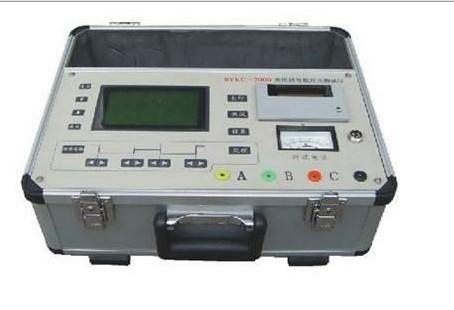

A DC resistance tester is an instrument specifically designed to measure the resistance value of conductors or electrical equipment under direct current conditions. This testing is crucial for assessing the condition of various components in power systems, such as transformer windings, motor windings, cable connections, etc., as it helps detect potential issues like loose connections, corrosion, or insulation damage. Below is a summary of an article about DC resistance testers, including their working principles, types, application areas, and usage precautions.
Overview of DC Resistance Testers
Working Principle
Basic Concept: A DC resistance tester applies a stable DC voltage to the test object and measures the current flowing through it to calculate its resistance. According to Ohm's law,
where R is resistance, V is voltage, and I is current.
Accuracy Requirements: To obtain accurate results, the tester needs to provide a high-precision voltage source and current measurement capability, along with good temperature compensation to reduce the influence of environmental factors.
Types
Handheld/Portable: Small size, lightweight, suitable for on-site quick testing, usually with automatic range switching.
Benchtop/Laboratory-grade: Suitable for more complex and precise applications, offering higher measurement accuracy and additional features such as data logging and analysis.
Micro-ohmmeter: Specifically designed to measure very low resistance values (micro-ohm level), commonly used for contact resistance testing.
Double Bridge: Uses the Kelvin four-terminal method for measurement, eliminating errors caused by lead resistance, suitable for high-precision requirements.
Application Areas
Power Industry: Regularly inspect the condition of key components such as transformer windings, generator stator and rotor windings.
Transportation: Maintenance of electrical circuits and equipment in rail vehicles, ships, and aircraft.
Manufacturing: Ensure the good condition of motors, switches, and other electrical devices used on production lines.
Research and Education: Material research in laboratories, teaching demonstrations, etc.
Advantages
High Accuracy: Modern DC resistance testers use advanced technology and algorithms to provide highly accurate measurement results.
Easy Operation: Most models come with user-friendly interfaces, supporting one-button operation, simplifying complex setup processes.
Versatility: In addition to basic resistance measurement, some advanced devices integrate other functions such as temperature compensation, data storage, and transmission.
Good Safety: Built-in overload protection mechanisms ensure the safety of operators.
Usage Precautions
Correct Wiring: Ensure all connections are firm and reliable to avoid measurement errors caused by poor contact.
Warm-up Time: Some high-end instruments require a certain warm-up time to achieve optimal performance; please refer to the instructions in the manual.
Environmental Conditions: Try to measure in a stable and interference-free environment to avoid temperature changes affecting the results.
Regular Calibration: To ensure long-term accuracy, calibrate according to the manufacturer's recommended intervals.
Safety Measures: When working in high-voltage environments, appropriate safety precautions must be taken, such as wearing insulating gloves and boots.
Conclusion
DC resistance testers are one of the important tools to ensure the safe operation of electrical systems, playing an irreplaceable role in multiple industries. With technological development, future DC resistance testers will become more intelligent and portable, providing users with more efficient and convenient services. Choosing the right tester and mastering the correct usage methods are crucial for obtaining reliable test results.
I hope this article provides you with a comprehensive understanding of the basic knowledge and importance of DC resistance testers. If you have any specific questions or want to learn more details, please feel free to let me know!