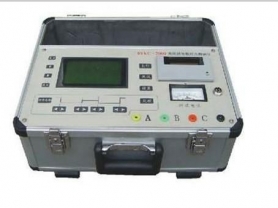

cables, transformer windings, motor coils, etc. It is widely used in power system maintenance, manufacturing process quality control, and electrical equipment repair. The following is a detailed introduction to the DC Resistance Tester:
Working Principle
The DC Resistance Tester applies a stable DC current to the object under test and then measures the resulting voltage drop to calculate the resistance value. According to Ohm's law R = V/I, where R is resistance, V is voltage drop, and I is the current through the conductor. This measurement method effectively eliminates the inductive and capacitive effects caused by AC, providing more accurate resistance readings.
Main Functions and Features
High-precision measurement: Uses advanced electronic technology and algorithms to ensure high accuracy of measurement results.
Wide range coverage: Can adapt to resistance measurement needs from micro-ohms to mega-ohms, suitable for various types of conductors and components.
Fast response: Has a relatively fast test speed, allowing multiple consecutive measurements in a short time, improving work efficiency.
Temperature compensation: Built-in temperature sensor or external interface allows temperature correction to eliminate the influence of ambient temperature changes on measurement results.
Data storage and transmission: Supports large-capacity data recording and can transmit data to a computer via USB, RS-232, or other communication interfaces for further analysis.
Portable design: Many models are compact and lightweight, easy to carry to the field, suitable for outdoor operations.
Multiple protection mechanisms: Equipped with overcurrent and overvoltage protection functions to ensure the safety of operators and the integrity of the equipment itself.
Application Fields
Power industry: Power plants, substations, distribution stations, and other facilities use DC resistance testers to check the contact resistance of key parts such as cable connections and switch contacts, preventing heating faults caused by poor contact.
Manufacturing: Factory production lines use this instrument to test the quality of finished products, such as whether the conductivity of wires and cables meets standards.
Electrical equipment maintenance: Regularly conduct DC resistance tests on large electrical equipment such as transformers and motors to monitor the condition of internal windings and detect potential problems in a timely manner.
Scientific research and education: Laboratories study the electrical properties of new materials, or use it as a teaching tool to help students understand circuit principles.
Usage Precautions
Correct wiring: Ensure all connections are correct to avoid dangerous or inaccurate results due to incorrect wiring.
Safety protection: Operators should wear appropriate personal protective equipment (PPE), such as insulating gloves and boots.
Warm-up time: Some high-end models may require a certain warm-up time to reach optimal working condition; follow the instructions in the manual.
Regular calibration: To maintain measurement accuracy, calibration and maintenance should be performed according to the manufacturer's recommended intervals.
Environmental conditions: Ensure the working environment meets equipment requirements, such as temperature and humidity, to avoid adverse effects on testing.
Future Development Trends
With technological advancements, future DC resistance testers may develop in the following directions:
Increased intelligence: Introduce more automation functions, such as automatic diagnosis and remote monitoring, to simplify operation processes.
Multi-functional integration: Develop comprehensive testing platforms that integrate multiple testing functions to meet broader application needs.
Green and environmentally friendly design: Optimize hardware structure and working modes to reduce energy consumption and minimize environmental impact.
Big data applications: Combine emerging technologies such as the Internet of Things (IoT) and cloud computing to achieve massive data analysis and predictive maintenance, further improving work efficiency and service quality.
If you are writing an article about DC resistance testers, the above content should provide you with a comprehensive and in-depth understanding. If you have more specific topics or details you would like to explore, please feel free to let me know.